
Improve Medical Culture
Providing medical internships for over 10 years
Our mission is to reshape the culture of medicine by advocating for compassionate care and fostering supportive environments where future healthcare professionals can thrive.

We are now accepting applications for the 2027 Pre-health Internship.
Admission is rolling.

Summer Lecturers and Guest Speakers
Physicians & Surgeons. Residents & Medical Students. Nurses & PAs. Learn from them all!
Students in this program learn directly from practicing healthcare professionals across multiple specialties, including physicians, surgeons, physician assistants, nurses, and recently matched residents. These are individuals actively working in hospitals, academic centers, and private practices, not theoretical instructors. Each session provides real insight into what a career in medicine actually looks like, along with practical guidance on how to get there. Students learn what it takes to succeed in medical school applications, residency, and clinical practice from people who have recently gone through the process or are actively doing the work. This is unusually high-level access, with students gaining direct exposure to healthcare professionals from institutions including Stanford, Columbia, Vanderbilt, and Cornell. Students also have the opportunity to ask questions and engage directly with speakers. This level of exposure helps students make informed decisions early, build stronger applications, and gain a clear advantage over their peers pursuing healthcare careers.

Kirsten Norell, MD
Dr. Norrell is a pediatric orthopaedic surgeon and Clinical Assistant Professor of Pediatric Orthopaedic Surgery in the Department of Orthopaedic Surgery at the University of Florida. She earned her medical degree from The George Washington University, completed her orthopaedic surgery residency at the University of Missouri–Kansas City, and completed fellowship training in pediatric orthopaedic surgery at Lucile Packard Children’s Hospital Stanford. Her clinical interests include developmental hip dysplasia, neuromuscular disorders such as cerebral palsy, clubfoot, limb deformity, and pediatric trauma. She is also involved in global health work for children with complex deformities and has a strong interest in mentoring medical students and residents. Dr. Norrell brings students exposure to surgical careers, pediatric subspecialty practice, musculoskeletal medicine, and the training path to becoming an orthopaedic surgeon.


Clausyl J. “C.J.” Plummer II, MD
Dr. Clausyl is an Assistant Professor in the Department of Physical Medicine and Rehabilitation at Vanderbilt University Medical Center and Medical Director of Vanderbilt Stallworth Rehabilitation Hospital. He completed his M.D. at The George Washington University and earned his B.S. in Biomedical Sciences from Oakwood University. Vanderbilt notes that his work focuses on brain injury medicine, with clinical interests in spasticity management, lifestyle medicine, and community reintegration for patients recovering from traumatic and acquired brain injuries. He is the Brain Injury Director at Vanderbilt Hospital. Dr. Plummer offers students a valuable look at PM&R, brain injury medicine, rehabilitation careers, and how physicians help patients recover function and quality of life after serious neurologic injury.

Dr. Trilochan Hiremath, MD, MBA
Dr. Hiremath is currently in private practice radiology and former Assistant Professor of Radiology at Weill Cornell Medicine and an Assistant Attending Radiologist at New York-Presbyterian/Weill Cornell Medicine. He is part of the Emergency Imaging Division. He has training and academic affiliations including Columbia University Irving Medical Center. His background gives students insight into radiology, emergency imaging, hospital-based physician practice, and how imaging guides real-time diagnosis and decision-making across specialties. For students considering medicine, Dr. Hiremath can speak about the path to becoming a radiologist, the role of radiology in acute care, and the intersection of medicine, technology, and hospital systems.

Ginger E. Shupe, MD
Dr. Shupe is a board-certified psychiatrist and serves as Medical Director of Outpatient Psychiatry at Larkin Community Hospital. She is also listed as Clinical Psychiatry Faculty in Larkin’s Graduate Medical Education program. Public professional profiles identify her as a graduate of the University of Miami Leonard M. Miller School of Medicine. Her clinical work includes general psychiatry, and her public interviews and faculty roles suggest particular strength in mood disorders, treatment-resistant depression, psychopharmacology, and psychiatric education. Dr. Shupe gives students exposure to modern psychiatric practice, psychiatric residency teaching, outpatient mental health care, and emerging treatments in depression.

Seth G. Rosenblatt, MD, MPH
Dr Rosenblatt, MD is a board-certified psychiatrist who is also board certified in Addiction Medicine. He is the founder of Vive Treatment Centers and has also been listed with VHC Health Psychiatric & Addiction Services and Greenbrook TMS. He graduated cum laude from Rice University with a bachelor’s degree in psychology, earned both an MPH in International Health and a master’s degree in International Affairs from George Washington University, and completed his psychiatry residency at George Washington University after an internal medicine and psychiatry internship. His treatment focus includes addiction and substance use disorders, alcohol use disorder, anxiety disorders, bipolar disorder, depression, LGBTQ psychiatry, and HIV psychiatry. Dr. Rosenblatt can speak to students about psychiatry, addiction medicine, entrepreneurship in medicine, physician leadership, and building innovative treatment programs.

Kelly Hof, BSN, RNC-EFM
Kelly Hof is a labor and delivery nurse, prenatal coach, and birth educator. Her public profile describes more than a decade of experience supporting birthing parents and newborns, and her credentials include BSN and RNC-EFM, which reflects certification in inpatient obstetric electronic fetal monitoring. Through her birth education and coaching work, she focuses on helping women prepare for labor, birth, advocacy in the hospital setting, and the emotional side of childbirth. She brings a practical maternal-health perspective that is especially useful for students interested in obstetrics, nursing, labor support, women’s health, and patient education. Kelly can speak about what labor nurses actually do, how hospital childbirth works in real life, communication with patients and families, and how to support confident, informed birth experiences.

Riley Trainor, DO
Riley Trainor is a graduating medical student at Lake Erie College of Osteopathic Medicine, Seton Hill, with a background that includes healthcare, research, and technology. She recently matched into psychiatry residency. Riley brings a near-peer perspective that is especially helpful for high school and college students trying to understand how to navigate the path from pre-med to medical school and then into residency. She can speak candidly about DO school, applications, interviews, the Match process, choosing psychiatry, and what students can do now to become stronger applicants later.

Aisha Hasan, PA-C,
Aisha Hasan is a certified Physician Assistant and Lead Injector at ProMD Health in Ashburn, Virginia. She earned her Bachelor of Science in Biology, with minors in Psychology and Spanish, from the University of Maryland, Baltimore County, and completed her Master’s in Medical Science and Physician Assistant Studies through Anne Arundel Community College and St. Francis University in 2012. She is a member of the American Academy of Physician Assistants and is fluent in English, Spanish, Urdu, and Hindi. Aisha specializes in aesthetic and regenerative medicine, with expertise in injectables, biostimulators, and hormone therapy. She is known for her strong communication skills, patient-centered approach, and focus on achieving natural, confidence-enhancing results. Aisha offers students a valuable perspective on the Physician Assistant career path, including education, scope of practice, work-life balance, and alternative careers in medicine outside of the traditional physician route. She can also speak about aesthetics, entrepreneurship in medicine, and how medical providers build patient trust and long-term relationships.

Stephanie Waggel, MD, MS, PMH-C
Dr. Waggel is the founder of Improve Life PLLC, a physician-owned outpatient psychiatric practice with locations in Ashburn and Reston, Virginia. She earned her medical degree (MD) and Master of Science (MS) and holds the Perinatal Mental Health Certification (PMH-C), reflecting specialized training in psychiatric care during pregnancy and postpartum. Dr. Waggel’s clinical work focuses on general adult psychiatry, with a particular interest in perinatal mental health, complex medication management, and individualized treatment planning. In addition to her clinical practice, she is actively involved in medical education and research, leading student-driven projects including systematic reviews on medication use in pregnancy and mentoring pre-health students pursuing careers in medicine. She also founded Improve Medical Culture, an initiative focused on improving medical education and providing structured internship opportunities for students interested in healthcare. Dr. Waggel brings students a unique perspective that combines clinical medicine, research, and physician-led practice ownership. She can speak on topics including psychiatry, perinatal mental health, medical education, research methodology, and navigating the path from pre-med through clinical practice.

Riley Decker
Riley Decker is a recent medical school admit who can provide students with a highly current, real-world perspective on the medical school application process, including the MCAT. Through her recent acceptance into an M.D. program, she brings up-to-date insight into what admissions committees are actually looking for today, including academic preparation, extracurricular involvement, clinical experience, personal statements, and interview performance. Riley can walk students step-by-step through the modern application process, including AMCAS, timelines, common mistakes, and how to stand out in an increasingly competitive environment. Her near-peer perspective allows students to ask practical questions and gain clarity on what they should be doing now in high school or college to successfully gain acceptance into medical school. She can also answer questions about research. She is an author on The psychological impact on American healthcare workers during the COVID-19 pandemic: an initial scoping review.

Sri Konagalla
Sri Konagalla will be speaking on her recent acceptance into medical school. She will discuss MCAT, interviews, and the medical school application and admissions process. Sri is a researcher with a strong interest in medicine, neuroscience, and clinical outcomes. She has worked with Improve Life PLLC for 7 years. She has contributed to academic research, including authorship on Improve Life PLLC published study, The psychological impact on American healthcare workers during the COVID-19 pandemic: an initial scoping review, reflecting early experience with scientific writing, data analysis, and evidence-based medicine. In addition to her research work, Sri has been recognized in his local community for her academic achievements, leadership, and commitment to pursuing a career in healthcare. Her interests include understanding how research translates into real-world patient care and improving outcomes through thoughtful, data-driven approaches.
Update: Riley Trainer's Residency Match in Psychiatry
Riley Trainer’s match into psychiatry residency is incredibly well deserved. During her rotation with Dr. Waggel at Improve Life PLLC, she demonstrated an exceptional level of professionalism, dedication, and intellectual curiosity that set her apart from the very beginning. She approached every patient interaction with thoughtfulness and care, consistently showing an ability to connect, listen, and contribute meaningfully to treatment planning. Patients responded positively to her presence, and it was clear she brought both compassion and maturity into the clinical setting.
Throughout the rotation, Riley gained experience across a wide range of psychiatric conditions and took an organized, data-driven approach to her learning. She independently tracked her patient encounters in a structured and visually effective way, reflecting both her attention to detail and her commitment to truly understanding the scope of psychiatric practice. Beyond clinical work, she showed a strong investment in education and team collaboration. She completed multiple projects on clinically relevant topics, including the brain-gut connection, OCD treatment, off-label medication use, GLP-1 agonists, and the relationship between birth control and acne. She not only presented these topics to the team but also reinforced learning through interactive discussions and quizzes, elevating the educational environment for everyone.
Riley consistently demonstrated strong work ethic, punctuality, and professionalism. She integrated seamlessly into the team and was always proactive in seeking opportunities to learn and contribute. Her clinical insight, academic initiative, and genuine compassion for patients make her a standout future physician.
I have no doubt that Riley will thrive in psychiatry residency and continue to grow into an exceptional and thoughtful psychiatrist. Congratulations, Riley, on matching into psychiatry at Virtua Health. This is just the beginning of a very bright future.

"Thank you so much Dr.Waggel! Working with you was my first true introduction to psychiatry and it shaped the rest of my time in med school as well as my future career! Learning from you and your patients was a joy. I'm incredibly grateful for your support and mentorship."
- Riley Trainer
At Improve Medical Culture, we train the next generation. Thank you to Improve Life PLLC Psychiatry in Ashburn and Reston, Virginia for your donation toward covering the cost of these clinic-based internships and allowing us to use the rooms from your professional office rentals.


1/26/2026 Update: Research Internship has only a few spots left
1/28/2026 Update: Currently a waitlist for the Research Internship
2/10/2026 Update: A spot opened and the top waitlisted student was accepted. Spots are still open for the Marketing Internship
2/22/2026 Update: The Research and Marketing Internships for the 2026 Spring Semester are full - just because we are currently full doesn't mean you shouldn't still apply. GET YOUR APPLICATIONS IN AS EARLY AS POSSIBLE! If a student withdraws or is removed, you want to be at the top of the list to take their spot!
Access the 2026 Summer Pre-health Internship for FREE by passing the Research or Marketing Internship
Rolling admission: it benefits you to apply ASAP.


Strengthen Your Medical School Application
How This Internship Benefits You
Most of you are here because you want to apply to medical school, PA school, or another health profession. Admissions committees consistently look for applicants who have real clinical experience, an understanding of patient care, and exposure to how healthcare works outside of a classroom. This internship gives you exactly that. Over the past ten years, Improve Life PLLC's internships have trained over 500 students. Many of these students are now doctors.
National data from medical school advising centers show that many programs require applicants to have an experience like this. The Association of American Medical Colleges (AAMC), states that successful applicants show direct involvement in patient care, strong communication skills, and a clear understanding of the realities of medicine. Many schools specifically flag clinical experience as a major factor in admissions because it proves you understand what you are signing up for.
This internship provides the type of experience that helps you stand out. You gain real skills in professionalism, patient communication, medical documentation, diagnostic reasoning, and understanding the healthcare system. You also learn how physicians think, how clinics function, and what it is like to work with actual patient scenarios. These are things you cannot learn from a textbook.
You are also building a long record of involvement with a physician led medical practice. Medical schools value applicants who work with physicians, who can speak confidently about clinical concepts, and who show that they can handle responsibility. Your weekly assignments, journal clubs, patient case write ups, Mini Med School sessions, and required participation hours build a strong portfolio that you can talk about during interviews.
Many internships around the country charge tens of thousands of dollars for experiences like this. Our program offers similar educational value but without the extreme cost. Because this internship is rigorous and structured, it can be added to your application as a long term clinical and academic experience, not a short and superficial experience.
Graduate and medical schools look for applicants who have demonstrated interest in medicine over time. This internship gives you that record. When admissions committees ask you to talk about a clinical experience that shaped your understanding of medicine, you will be able to discuss your assignments, the clinical cases you worked through, the professional skills you learned, your participation in Mini Med School, and how you grew during the program. If you pass, you will receive a letter of recommendation.
In short, this internship strengthens your application by giving you real experience, real skills, and a meaningful story to tell. It helps you stand out in a competitive pool and makes your future applications stronger, clearer, and more authentic.


By: Angelina Le-Hoang
Posted: 4/11/2026
Up to 40% of entry-level jobs including internships could be soon automated by AI. Entry-level roles are particularly vulnerable because they rely heavily on routine, repetitive tasks such as data entry, basic analysis, and administrative support. According to the Future of Jobs Report, about 40% of employers expect to reduce their workforce where AI can automate tasks, signaling a major shift in how companies structure entry-level work (World Economic Forum, 2025). While this statistic refers broadly to the workforce, entry-level positions are the most exposed. Additional research suggests that nearly half of all work activities could be automated using current technologies, further reinforcing the idea that a significant portion of early-career roles may be at risk (McKinsey & Company, 2023).
This shift is also making it much harder for students to even get their foot in the door. Internships help students prepare for and obtain job opportunities. However, internships are becoming more competitive with about 2.5 times more applicants competing for the same roles. As companies rely more on AI tools, they are hiring fewer interns, which has contributed to a noticeable decline in entry-level opportunities and a surge in competition for the positions that remain (CNBC, 2025). This aligns with real-world data showing that technology internships now receive roughly 2.5× the number of applications compared to previous years, especially in fields like software engineering and data science (ITPro Today, 2025). At the same time, entry-level opportunities are declining overall, meaning more people are competing for fewer positions. This growing imbalance suggests that AI is not only reducing the number of entry-level roles available but also intensifying competition for the ones that remain.
Works Cited
Brynjolfsson, E., et al. (2025). Canaries in the coal mine: AI and entry-level employment. Stanford Digital Economy Lab.
ITPro Today. (2025, August 29). AI’s career ladder crisis: Entry-level tech jobs are vanishing.
CNBC. (2025, September 7). AI is not just ending entry-level jobs—it’s reshaping them. https://www.cnbc.com/2025/09/07/ai-entry-level-jobs-hiring-careers.html
Teutloff, O. (2025). Winners and losers of generative AI: Early evidence. Journal of Economic Behavior & Organization.
World Economic Forum. (2025). The future of jobs report 2025. https://www.weforum.org/reports/the-future-of-jobs-report-2025
Why is it so hard to find an internship this year?



How This Internship Helps With Scholarships, Grants, and Financial Aid
Starting in the 2026 application cycles, graduate and professional programs will have stricter limits on federal loans. Many students will need to rely on scholarships, grants, and merit based financial aid to cover the gap. Strong extracurricular experiences can make a major difference in how much funding you receive, and this internship can help you stand out.
Financial aid offices and scholarship committees look for evidence that you are committed to your future profession. They award money to applicants who show dedication, leadership, and a clear understanding of the field they want to enter. This internship provides all of that. It creates a documented record of your involvement in healthcare and shows that you have taken initiative to gain experience in a physician led environment.
Many scholarships include essay questions where you must describe a meaningful experience, a challenge you overcame, or a time when you learned something important about the career you want to enter. The work you complete in this program gives you strong material to write about. You will be able to reference Mini Med School, patient cases, journal clubs, your graded assignments, and the professional skills you practiced each week. These essays stand out compared to students.
Some grants and university scholarships also ask for proof of community involvement or long-term commitment to a field. Being enrolled in a structured healthcare internship like this, with defined hours, a syllabus, and graded academic work, can qualify as both. It helps show that you are building your future on purpose, not by accident.
Universities also like to see mentorship and continuity with one organization. Since this internship works in stages, you can continue into higher level research internships or more advanced clinical roles once you complete this one. The longer you stay involved, the stronger your financial aid profile becomes.
In a world where loans will no longer cover all of the cost of medical school, PA school, nursing school, or graduate programs, small advantages matter. A strong internship record can make a real difference in how much free money you receive. It can also help you qualify for special programs, pipeline opportunities, or university-based funding that are only open to students with healthcare experience.
This internship strengthens your scholarship applications and improves your chances of receiving financial support because it shows commitment, professionalism, maturity, and real exposure to medicine. It helps you compete for grants and reduces your need for loans later.


Medication Safety Research
March 2026 UPDATE: All spring positions are filled.
To apply for summer 2026, you must have research experience, 3 references, and one reference must confirm first-hand knowledge of your research experience. For the summer, the internship is not divided into junior or senior. That is only during the fall and spring. See our research page for more information.

Physical Exam, First Aid, and Suture Skills

Our program gives students rare exposure to real clinical skills in a safe and structured environment lead by a medical doctor. Under the direct supervision of a physician, students learn the foundations of physical examination, clinical reasoning, and bedside professionalism. They practice core skills such as taking vital signs, understanding normal versus abnormal findings, using medical instruments, and approaching a patient with confidence and respect. Parents consistently tell us that this portion of the internship helps their child become more mature, more focused, and better prepared for future health-related careers.
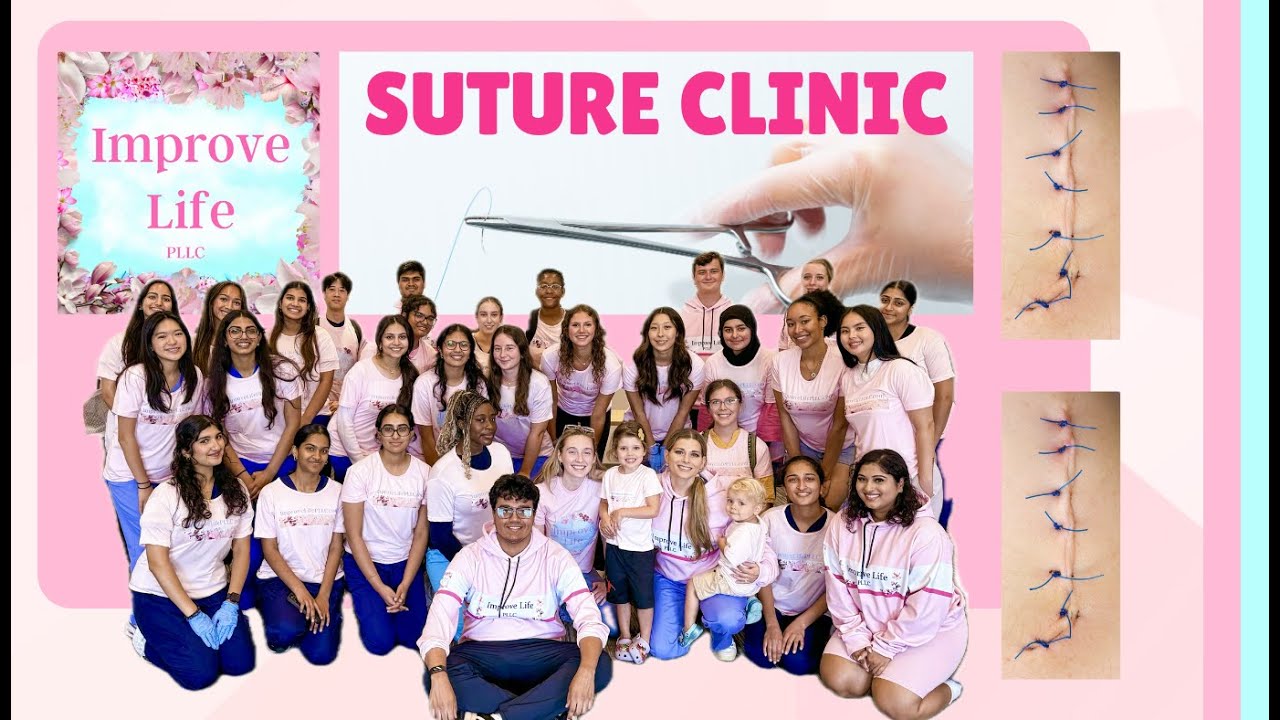
One of the most anticipated components of the internship is our Suture Clinic. During this hands-on session, students learn sterile technique, wound-care basics, and introductory suturing on synthetic practice models. This is the same type of early training used in medical and nursing school skills labs. It is fully supervised, highly structured, and designed to build both competence and curiosity. Many students discover a new passion for surgery, emergency medicine, dermatology, or primary care through this experience.
These sessions are intentionally crafted to be safe, age-appropriate, and confidence-building. Students do not practice on each other; all procedures are performed on medical-grade simulation materials. Our goal is to give students opportunities that are simply not available in the typical classroom. Parents appreciate that their children gain exposure to real medical tools and techniques without the pressure or environment of a clinical shift.
Families often choose this internship because it strengthens college applications, prepares students for pre-health pathways, and gives them meaningful experiences to talk about in interviews, scholarship essays, and personal statements. These hands-on sessions are memorable and empowering, and they help students stand out in a competitive academic landscape.

Top Doctor
Congratulations to our Medical Director, Dr. Stephanie Waggel, on this incredible honor! More than 13,000 physicians across DC, Maryland, and Virginia cast votes for colleagues they would personally recommend to patients. Each ballot required a current medical license, with one vote per doctor and no self-voting allowed, making this recognition especially meaningful. It’s clear that Dr. Waggel is highly respected and deeply valued within our community!
If you'd like her to be your psychiatrist check out Improve Life PLLC. If you are interested in her concierge service see Mom's Physician.


Founder: Improve Medical Culture & Improve Life PLLC
As a resident doctor, Dr. Waggel was diagnosed with kidney cancer. She was faced with an unsupportive work environment. Dr. Waggel founded Improve Medical Culture to change the culture of medicine and offer resources for healthcare providers. She now offers training to premed and medical students that are supportive rather than toxic. Topics are vast ranging from pediatrics to geriatrics. You may watch some of the topics on our YouTube channel. Funding for these free experiences provided by Improve Life PLLC Psychiatry of Reston and Ashburn, VA.




NEW: Check Out Our New Piece on Grade Inflation for Premeds!
Grade inflation is the phenomenon when students’ grades are higher than the level of student
performance. Across many American universities, particularly elite institutions, A-range grades
have become increasingly normalized. As a result, average undergraduate GPAs have steadily
risen over the past several decades (Crimson Education; Independent Institute). While higher
grades may appear beneficial, this phenomenon presents serious challenges for students
pursuing competitive professional pathways, especially premed students. Because medical
school admissions rely heavily on GPA as a measure of academic readiness, grade inflation can
distort evaluation, weaken academic rigor, and create a false sense of preparedness.
Grade inflation has become widespread across U.S. higher education. At Harvard College,
A-range grades accounted for roughly 24% of all grades in 2005, but by 2025, more than 60%
of all grades awarded were in the A range, with the average GPA approaching 3.8 (Harvard
Magazine; Crimson Education). This dramatic shift shows that high grades have become
increasingly common regardless of performance differences. As grades rise uniformly, they lose
their ability to represent meaningful distinctions in academic achievement. For premed students,
whose success depends on demonstrating academic excellence in rigorous coursework, this
normalization of inflated grades undermines the reliability of one of the most important metrics in
their applications.
One of the most significant consequences of grade inflation for premed students is distorted
academic evaluation. When most students earn A’s, it becomes difficult to distinguish truly
exceptional performance from average work. Admissions committees must compare applicants
from institutions with widely varying grading standards, making GPAs less informative (ESM
Prep). A student with a 3.9 GPA from a school with severe grade inflation may not perform at
the same academic level as a student with a 3.6 GPA from a more rigorous institution. This lack
of standardization introduces inequity into admissions and weakens confidence in GPA as an
objective indicator of readiness for medical school.
Inflated grades may also create a false sense of preparedness among premed students. High
GPAs can give students confidence that they have mastered prerequisite material, even when
their understanding may be incomplete. Once in medical school, where grading standards are
often stricter and expectations are uniform, these students may struggle academically
(Independent Institute). This gap between perceived and actual preparedness can contribute to
stress, burnout, and reduced academic performance, ultimately undermining student well-being
and success.
Grade inflation is a pervasive issue that reshapes the academic landscape of higher education.
For premed students, its consequences are especially serious because grade inflation distorts
evaluation, weakens academic rigor, and fosters unrealistic perceptions of readiness. While
intended to support student morale, inflated grading ultimately diminishes the credibility of
academic achievement and undermines fairness in competitive professional pathways.
Addressing grade inflation is therefore essential to preserving the integrity of premedical
education and ensuring that future physicians are both rigorously trained and accurately
evaluated.
References:
Crimson Education US. ‘Soul-Crushing’: Students Slam Harvard’s Grade Inflation Report.
Crimson Education, 2025,
https://www.thecrimson.com/article/2025/10/30/students-react-grading-report/
ESM Prep. The High Cost of Grade Inflation. ESMPrep.com, 2026,
https://www.esmprep.com/articles/the-high-cost-of-grade-inflation.
Harvard Magazine. “Grade Inflation Reaches New Highs.” Harvard Magazine, 2026,
https://www.harvardmagazine.com/university-news/harvard-summers-epstein-grade-inflation-cla
ss-2029.
Independent Institute. “The Pernicious Effects of Grade Inflation.” Independent.org, 29 Nov.
2025, https://www.independent.org/article/2025/11/29/the-pernicious-effects-of-grade-inflation/.
Minding The Campus. “Grade Inflation—Why Princeton Threw in the Towel.”
MindingTheCampus.org, 2014,
https://www.mindingthecampus.org/2014/10/15/grade-inflation-why-princeton-threw-in-the-towel/
Check out this blog post and other health related blogs under the "2026 Updates with Angelina" page!

Intern of the Year 2025
Angelina Le


Bhuvana Lavu
We are proud to give Bhuvana the Most Improved in Professionalism Award. She earned this for two important reasons. First, she showed remarkable empathy and accuracy when responding to a woman who is struggling with thyroid cancer. Her message was thoughtful, sympathetic, professional, and medically correct. Second, she received a question from a university official and reached out with a question. Dr. Waggel sent Bhuvana very quick answer because she was extremely busy. Dr. Waggel very much hoped Bhuvana would use her own independent thinking skills to extrapolate upon the reply. She did! Instead of repeating word for word, she used critical thinking to transform my answer into a complete and professional email that fully answered the question. She understood the intent behind the brief response and expanded it into something excellent. This showed strong judgment, independence, and growth. I am very proud of her progress.

Learn from a Network of Leading Physicians
Dr. Waggel has connections to top doctors through her role as ambassador and social chair
At Improve Medical Culture, our internship program goes beyond psychiatry. Students gain the rare opportunity to meet and learn directly from other top health professionals, including specialists in neurology, dysautonomia, addiction medicine, and more. Through recorded lectures, Q&A sessions, and collaborative teaching, interns see how different areas of medicine connect and work together. This unique exposure not only strengthens clinical understanding but also provides valuable networking with doctors who are leaders in their fields.


Helpful or Helpless?
Questioning tasks as a medical student
When to Ask Questions vs. When to Just Do It (Clinical Training Expectations)
In clinical training, attending physicians often give direct tasks such as writing a note, checking labs, visiting a patient, or faxing a document. In most cases, these requests are not invitations for debate or prolonged clarification.
When you should just do it:
-
The task is clear and within your role
-
The request is routine (write a note, check labs, see a patient, fax paperwork)
-
You know where to find the information
-
The instruction does not involve patient safety uncertainty
In these situations, the expectation is prompt action. If an attending asks you to do something, you should assume it is needed now, not later.
If you don’t know how to do part of the task, look it up. If you can’t find something, search the chart, the EMR, or ask a specific question after you’ve already tried to figure it out yourself.
When asking a question is appropriate:
-
You are genuinely unsure about patient safety
-
The instruction is unclear or conflicting
-
You do not have permission or access to complete the task
-
You have made a thorough attempt to find the answer and cannot
Good questions are focused and efficient, not open-ended or excessive.
What is not viewed favorably in clinical settings:
-
Asking questions that could be answered by checking the chart
-
Asking about minor preferences unless they truly matter
-
Delaying tasks due to over-questioning
-
Acting helpless instead of resourceful
Medicine values initiative, judgment, and follow-through. Strong students move work forward while knowing when to speak up for safety or clarity.
The goal is not to avoid questions. The goal is to know which questions matter, and when the best answer is simply to do the work.


Full Credit Participation
Abegia Negash
This award recognizes participation that reflects true engagement, critical thinking, and leadership in discussion. Abegia consistently demonstrated that she had carefully read and processed the material, and her comments went far beyond brief acknowledgments or generic responses. In particular, she showed strong insight during discussions on PRISMA methodology and search strategy, where she articulated why sensitivity and specificity matter in early screening and correctly emphasized the importance of not excluding studies prematurely. She also engaged thoughtfully in conversations about SPIN and reporting bias, contributing to group understanding of how framing and language can influence interpretation of research findings. Abegia was especially effective in discussions around professional communication in healthcare, including generational differences in communication styles, the risks of informal language in clinical and academic settings, and the importance of clarity, tone, and precision. Her comments reflected an ability to connect theory to real-world clinical and professional contexts. Beyond her individual contributions, Abegia actively helped sustain dialogue by responding to others’ comments, asking follow-up questions, and inviting additional perspectives from fellow interns. Her participation consistently advanced group discussion and modeled the type of engaged, thoughtful communication expected in medicine and research.


Blog 08
Discover the real-world value of healthcare internships and fellowships at Improve Life PLLC. Learn how students gain clinical experience, professional skills, and insight into psychiatric care.

