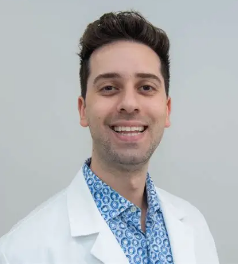
Interview with Dr. Sami Khaldieh, OD: Solaire Vision

By: Gloria Zhang
Gloria: Could you tell me a little bit more about your academic journey and what inspired you to become an optometrist specifically? I'm currently a high school junior, so I wanted to make this more relevant.
Dr. Khaldieh: I grew up locally and went to elementary school, middle school, and high school near me. I went to Oakton High School, then attended VCU, and after that I went to Drexel University for optometry school. Optometry school is not medical school: it's a four-year graduate program. There are fewer than 30 optometry graduate programs in North America, including a couple in Canada. Drexel, in Philadelphia, was the closest one, so that's where I chose to go.
As for how I got into optometry, my prescription is -14, which is one of the highest prescriptions I've seen, and I see prescriptions for a living. When I realized my prescription was much higher than normal, I also had a school project during my senior year where I had to shadow a doctor. Since I was always in and out of the eye doctor's office, I decided to shadow my optometrist. That experience opened my eyes to the patient experience because I was already an optometry patient. I realized I wanted to make sure what happened to me never happened to anyone else, so I dedicated myself to becoming an optometrist. I made that decision pretty early and stuck with it.
Gloria: What led you to open or join Solaire Vision?
Dr. Khaldieh: The short version is that most optometry practices in the area were doing things for the wrong reasons. At first, I thought what happened to me was the doctor's fault, but I later realized it was the system.
After graduating, I took a significant pay cut to work at a practice where I thought I could do things the right way. Six months later, that practice was bought by a large corporation whose priorities didn't align with mine. When I looked for another job, I realized many independent practices criticized corporations but were essentially trying to operate the same way.
At that point, I realized the only way to do things the way I believed they should be done was to open my own practice. I opened it almost three years ago.
Gloria: What does a typical day look like for you as an optometrist at your private practice?
Dr, Khaldieh: As an optometrist, my day starts like most medical professionals. I wake up, get ready, sit in NoVA traffic, and go to work. Your coworkers are one of the most important parts of the job. The respect you receive from your coworkers, your boss, and your patients has a huge impact on how much you enjoy your career.
Most medical professions are actually very similar. I specialize in eyes, while others specialize in teeth, the heart, muscles, or X-rays. What really separates careers isn't necessarily the body part you work with. It's your interest and your natural skills.
I enjoy optometry because it's a very social profession. I get to ask patients about their families, vacations, work, and how they use their eyes every day. I typically meet 15 to 25 people daily, and I enjoy hearing their stories.
Compared to some other professions, such as dentistry, optometry allows for much more conversation with patients. It's a profession where, if you have a good social battery, interacting with people can actually be energizing.
From the clinical side, we have some technician support, but optometrists perform much of the testing ourselves. We check for conditions like glaucoma, signs of brain disease, diabetes, and high blood pressure. We examine the front of the eye, the back of the eye, and everything in between. Finally, we determine the patient's prescription and make sure they're seeing as well as possible.
Like most medical professions, the process is similar: listen to the patient's concerns, gather data, analyze it, and explain the solution. The technical tasks themselves are actually one of the least important aspects when choosing a career. It's much more important to choose something you're naturally good at than something you simply think you'll love.
Gloria: I noticed that your practice recently rebranded from Beyond Eyecare to Solaire Vision. What inspired that change, and what did you hope it would accomplish for your private practice?
Dr. Khaldieh: That's a good question. We rebranded about three weeks ago because people were accidentally finding out that we were the best, and we wanted people to do the research, think that we're the best, and then come in and confirm that we're the best.
Humbly speaking, if you look at our reviews and the way people talk about us, you'll see that. This is a new practice, and we didn't know what we were doing when we first started, yet people still really enjoyed the experience with us.
We realized people were coming in because we were the closest office or because we accepted their insurance. Then they'd say, "Wow, I didn't realize this place was this good," or "This is the best experience I've ever had." We realized we were missing the mark with our marketing.
We wanted people to intentionally seek out the best care, the best service, the best customer service, and the best products. Then, when they came in, they could confirm through their own experience what their research had already suggested. Whether people use Google, ChatGPT, reviews, or recommendations from friends, if all of those sources point them toward a place that's excellent, and they experience exactly that, then that's a win.
Before, hardly anyone knew we existed. If nobody knows you exist, people only discover you by accident, and that doesn't help the business. The easiest part of my job is actually seeing patients. It's the least valuable thing I can do for the business. When I realized that what happened to me was a system failure rather than an individual doctor's failure, my goal changed. Instead of wanting to become the best doctor, I wanted to build the best system.
No matter which doctor a patient sees at Solaire Vision, they'll receive the same outstanding experience from beginning to end. I know what a great patient experience looks like because I've been seeing optometrists and ophthalmologists since I was four years old. My prescription was very high even then, and I've experienced many different practices growing up here. We take great pride in making sure everyone receives the best care possible.
Gloria: What advice would you give to a high school student who hopes to pursue a career in healthcare?
Dr. Khaldieh: Everyone has both internal and external purposes. An internal purpose might be wanting a nice house, a garage full of cars, or being able to buy your parents a home. Those are important, but they're relatively limited. Once people achieve those goals, if they don't have an external purpose, they often feel empty because they no longer know what they're working toward.
In healthcare, if you choose a profession that's growing rather than shrinking, you'll likely achieve your internal goals. You'll be able to earn a good living. What carries you through the difficult times is your external purpose. Graduate school is difficult. They will challenge you, so you need a strong reason for why you're there.
One thing I hear often from students is, "I just want to help people." That's not enough. Of course you want to help people, but you can help people by changing a tire, fixing a printer, setting up someone's computer, or becoming a doctor. Helping people alone isn't what distinguishes healthcare.
Instead, figure out what you're naturally good at. Many students tell me they aren't good at anything, but everyone has strengths. You may speak multiple languages, understand different cultures, communicate well, enjoy talking with people, or have other abilities you don't even recognize as valuable.
Write down everything you're good at and everything you're interested in. Then use a tool like ChatGPT and say: "These are my skills. These are my interests. I want to work in healthcare. Based on those things, what careers would fit me?"
You should also ask yourself whether having the title "doctor" is important to you. If it is, that's something to include because it changes the recommendations you'll receive. You should also think about the educational path you're willing to commit to. Medical school generally requires four years of medical school followed by about four years of residency. For me, I didn't want another four years after graduate school, so optometry was a better fit. Optometry school combines the education and specialization into a four-year graduate program.
No matter which healthcare profession you choose, the education will be difficult. If you don't have a clear reason for pursuing it, you'll constantly question yourself, and that makes it much harder to succeed.
The earlier you discover what you want to do, the clearer your path becomes. It's much easier to make good decisions when you have direction. That doesn't mean you have to know at 16 or 17. Some people don't figure it out until they're 22, and that's completely fine. But having some direction helps keep you moving forward instead of having to backtrack later.
One thing I always tell people is not to choose a career simply because it's your passion. For example, I have a friend who loves photography. But being a professional photographer isn't just taking pictures. You have to edit photos, market yourself, manage social media, communicate with clients, meet deadlines, and handle customer expectations. Most of the job isn't actually taking pictures.
The same thing happened to me. I thought I was choosing optometry because I loved eyes and wanted to improve the patient experience. I didn't realize that fulfilling that mission would eventually require me to become a business owner and build a system.
Today, only about 20% of my work is actually being an eye doctor. The other 80% is running the business. Ironically, seeing patients is the easiest, most relaxing, and least stressful part of my job.
Whatever career you choose, you're going to work hard. Eventually, every job feels like a job. That's why I encourage people to choose something they're naturally good at, because you'll still have to put in the work regardless.
Gloria: Thank you so much for sharing that advice. I actually see a local optometrist myself, so I never really realized how much goes into running a private practice. Hearing about the business side of healthcare and the importance of building strong systems has been incredibly insightful. Thank you again for taking the time to speak with me today. I know you're incredibly busy, and I truly appreciate your willingness to share your experiences and advice.
Dr. Khaldieh: It was my pleasure. When I was in high school, someone allowed me to shadow them for four hours. That experience completely changed the direction of my life. Because of that, I always try to make time for students who are exploring careers in healthcare. I know not everyone responds to outreach emails, so I'm happy to share my perspective whenever I can. I hope something from our conversation helps you as you continue exploring your future. And years from now, when you're in a position to mentor the next generation, I hope you'll do the same for someone else.
Dr. Sami Khaldieh is an optometrist located in Herndon, VA.
He is currently practicing at Solaire Vison


Thanks for sharing this wonderful interview! Liking Optometry because of how much social interaction he can have with his patients was really hartwarming. Not a lot of doctors or medical professionals take the time to have actual conversations with patients. This whole interview seemed so educational and relatable.
Thank you for sharing his story! I really enjoyed his last bit about how passion and work relate. I think especially as your younger your vision for yourself is a lot different than what it will end up being. Nonetheless, hearing from people who were recently our age helps put build context and mentorship in the future!
Dr. Khaldieh saying 80% of his job is running a business and only 20% is being a doctor hit me because for me these days it’s the same.
Thank you for sharing this interview! I really enjoyed learning about Dr. Khaldieh's journey into optometry and how his own experiences as a patient inspired him to pursue the profession. It was especially interesting to hear how a personal challenge shaped not only his career choice but also his commitment to improving the patient experience for others. One part that really stood out to me was his perspective on choosing a career based on your strengths and the type of work you enjoy, rather than simply following a passion. I also found it fascinating to learn how much of running a private practice involves building systems, leading a team, and creating a positive experience for patients. It's a great reminder…
Very insightful interview, it was great to learn more about Dr. Sami Khaldieh’s journey in medicine! It was especially interesting to see how the business side of his job, especially since there are many systemic issues in healthcare and I’ve noticed local healthcare businesses are being bought by corporations now as well